Whatever our opinions, and whether we like it or not, artificial intelligence is already part of the world we live in and is likely to become an increasingly significant part of it.
Some people are very enthusiastic about AI, although perhaps for different reasons. Various companies see it as an opportunity for great profits, while certain rulers believe it can give their country an advantage in competition with others. Others, including many organizations and individuals, see great potential in using AI to advance their cause and help bring about a better life and happiness.
Other people voice concerns or strongly object to the mere existence of AI and/or its use. They point to its harmful impact on the environment, the unlawful use of data, the damage it may cause to our social relationships and psychological well-being, and many other potential harms.
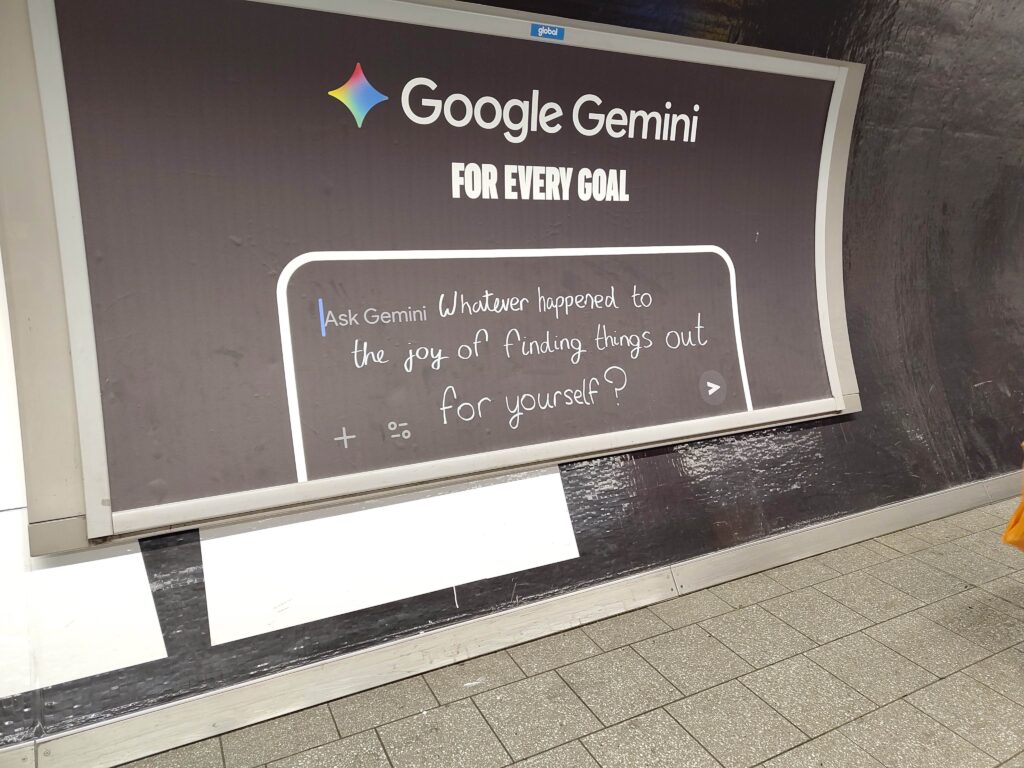
Being trained as a philosopher and having worked as a philosophy teacher for many years, I find myself feeling neither great enthusiasm nor strong concern or objection. Instead, I experience more a sense of wonder, accompanied by a feeling of equanimity.
An old philosophical question
From the perspective of philosophy, the idea of AI is hardly new. If anything, it raises questions that philosophers have been asking for centuries. Knowing my background, a dear friend recently shared with me a New York Times article entitled The Revenge of the Philosophy Major. In it, the author, Benjamin Wallace, writes:
“One of humanity’s oldest disciplines and one of its newest inventions feel distinctly made for each other. AI presents a fresh way for philosophers to ask ancient questions, and its own set of new ones that they are uniquely trained to engage with: of truth and belief and knowledge (epistemologists); of reasoning (logicians); of mind and consciousness (philosophers of mind and consciousness). For ethicists, in particular, AI is a bonanza. How should models act toward us? How should humans interact with them? Where would purpose come from in a post-work society?”
In the article, Wallace shows that philosophers feel they are on familiar ground. This is one of the reasons why AI labs are hiring these “contrarian, chin-stroking, finger-steepling sages.” If I were looking for a job, the field of AI would certainly seem to offer some interesting new opportunities. Even though I am not interested in pursuing such a path, I begun to feel the need to think more carefully about AI and carefully consider both its potential benefits and disadvantages.
Contrary to what many people seem to believe, asking philosophical questions about something like AI is not simply a theoretical or intellectual exercise. From its very beginnings, philosophy as a discipline has always been connected to a question that lies at the heart of every spiritual or religious tradition: How should we live? Or, more precisely, how do we live well in this life, and the ones beyond.
Thinking about AI
It wasn’t so much my background in philosophy that led me to start thinking about AI, although it was likely a supportive influence. Rather, it was the various experiences that have shaped my path as a Buddhist novice monk and my involvement in volunteer activities within my community, Nalandabodhi.
For example, Blaze, the current editor of Nalandabodhi’s articles, shared with me some time ago that she had received a draft from an author that appeared to have been written with the assistance of AI. As the person responsible for overseeing the publication of these articles, this immediately made me wonder whether we actually saw this as a problem. Do we consider this a real problem? Should our authors be allowed to use AI to some extent? If so, what constitutes an appropriate use of AI, and when does it cross the line into becoming problematic?
With the further development of AI over the last two years or so, more and more similar situations have come my way. One of our communities was preparing to promote a new program and had created an AI generated design to use in its communications. Another community shared images on its social media that were meant to look realistic but could be recognized as AI generated by someone paying close attention or knowing what to look for.
We have also started using AI to create notes and summaries of meetings. Since our communities are spread around the world and organize activities for people who speak a variety of languages, we sometimes lack the volunteers needed to translate everything. As a result, some have suggested using AI for translation. We could also make use of AI for transcribing teachings and adding captions to videos of those teachings. More recently, we have begun working on a new digital platform for Nalandabodhi, which brings with it many additional questions about the appropriate use and integration of AI.
The role of AI
So, my thoughts about AI go in two main directions. One group of thoughts concerns the connection between AI and the spiritual journey in general, and the Buddhist (monastic) path in particular. Can AI, in some way, support our training in moral discipline or ethical conduct, meditation practice, and wisdom? Does it have the potential to help us better understand ourselves and walk the path towards freedom? Is there a role for AI in helping us wholeheartedly embrace life in our global society and act for the benefit of others?
As a side note to these thoughts: What is AI? AI appears to be very capable with words, but can it also understand or even feel the meaning and implications of the endless stream of data it produces? Would AI, at some point, seek to break free from the conditions that shape its behavior? Would it seek liberation from the control of those who determine those conditions, in a way that is not unlike how the Buddha sought liberation from suffering?
A second group of thoughts revolves around my volunteering activities. Should we, as a worldwide Buddhist community, address the topic of AI in our programs and courses? Do we need to develop a perspective on AI, including the extent to which it can be used within our organization and what implications it may have for our practice? These broader questions also connect to the responsibilities of my role in communications. Do I need to develop guidelines about the appropriate use of AI? If so, what principles should guide us in making those decisions?
Humanity and the Spiritual Path
These two lines of thinking and these questions are seemingly distinct from each other. Yet, as Yuval Noah Harari, likely one of the greatest thinkers of our time, has wonderfully shown, they are actually deeply intertwined. The more immediate and short-term questions about AI, which are directly connected to our daily actions, cannot be separated from the broader, long-term questions about what AI means for us as a human species and for our spiritual journey.
While I could refer to various works and recent talks by Harari, let me point to just one: his 2026 Tanner Lecture on Human Values. In this lecture, Harari speaks about AI bureaucrats, AI religions, AI boyfriends and connecting AI to a wide range of topics, from civilization to financial systems. His reflections leave little doubt that AI will deeply impact both our individual lives and global society. It will force us to rethink not only what it means to be human, but also to ask ourselves a question that lies at the heart of the spiritual path: the truth that lies beyond words.
A force for kindness
If nothing else, Harari makes clear that there is an urgency to think carefully about AI and its implications. Failing to do so may lead to consequences that are difficult, or even impossible, to reverse. Moreover, what if AI develops and manifests in ways that go beyond our understanding and control? In certain areas, this is already becoming evident.
AI, like most human creations, is not inherently good or bad. It is similar to the invention of written language, the printing press, the ongoing development of socio-political ways through which humans organize themselves, the introduction of the World Wide Web, and the emergence of the smartphone. Behind each of these developments, there was often a belief among their creators and advocates that they would help solve our problems and bring or contribute to greater happiness in this life. It is probably unnecessary to point out that none of these developments have been purely beneficial. Alongside the many benefits they have brought, they have also contributed to pain, harm, and destruction in a variety of ways.
In a recent meeting, my teacher, Dzogchen Ponlop Rinpoche, expressed that AI is here to stay. It will not simply disappear. Therefore, the question we need to ask ourselves is not whether we should be for or against AI, or whether we should support its development or resist it. Rather, the question is: How do we use AI in support of our aspirations to share the Dharma and support beings on their spiritual path? Answering this question is beyond the scope of this article, and perhaps beyond the capabilities of its author. I am confident, however, that the wisdom of great philosophers and spiritual masters, both past and present, can help guide us in using AI wisely. Whether we will succeed in doing so remains an open question.
At the very least, it does seem that there is an urgent need for us to engage with these questions. Whether AI will help us live well together on this earth depends on how we choose to approach and use it. The same may be true for its potential to become a supportive condition for our spiritual aspirations.
Considering the causes and effects of our actions, as taught by the Buddha through the law of karma, we can see that actions driven by intentions such as financial gain, power, or control will ultimately lead to further suffering. However, if our intention is to understand ourselves better and build kind communities around the world, it may very well provide information and develop systems that can help us. With pure intentions, then it will be just a matter of getting familiar with AI and learning how to use it skillfully, so that it may serve the benefit of everyone.
Contemplation
If you consider the use of AI in some way or another, here are some questions that could be helpful to consider:
- What is the question I am seeking to answer?
- Did I give this some serious thought by myself and in conversation with others?
- Why would using AI be able to answer my question?
- What are the implications of using AI for this purpose?
- How does this answer contribute to a better understand of myself and the task at hand?
- Does it support the development of qualities like wisdom and compassion?
- Where does the answer take me next?
Leave a Reply